
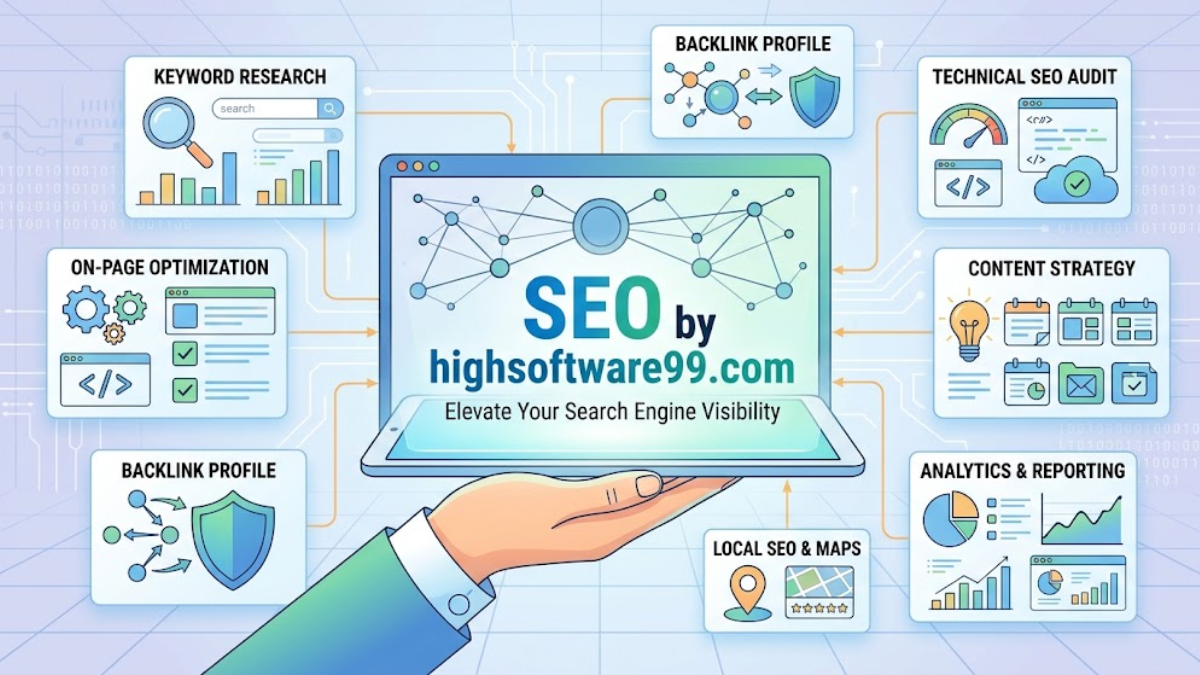
Learn how SEO by highsoftware99.com can guide your strategy. This complete guide covers keyword research, on-page and technical SEO, content, link building, analytics, and practical examples to help you rank higher.
Search engines are still the main way people find software, services, and answers online. A page that ranks on the first page of Google earns steady, compounding traffic without paying for every click, while a page buried on page three might as well not exist. That is why a clear SEO strategy matters for site owners, bloggers, marketers, and software businesses.
This guide explains SEO by highsoftware99.com as a practical framework you can follow, covering search engine optimization, keyword research, on-page SEO, technical SEO, content creation, link building, and performance tracking. Whether you run a software review site, a small business blog, or an online store, you will find actionable steps and real examples you can apply immediately.
Search algorithms change often, but the fundamentals do not: understand what users are searching for, publish the best answer, make your site easy to crawl and fast to load, and earn trust from other websites. The sections below walk through each of those pillars.
What SEO by highsoftware99.com Means and Why It Matters
Search engine optimization is the practice of improving a website so it appears higher in organic search results for relevant queries. When people talk about SEO by highsoftware99.com, they are generally referring to a structured approach to optimization: a repeatable process rather than a set of random tricks.
The Three Pillars of Modern SEO
Almost every effective strategy rests on three pillars:
- Content relevance: Does your page answer the searcher’s question better than competing pages?
- Technical health: Can search engines crawl, render, and index your pages without friction?
- Authority: Do other reputable sites reference and link to you?
Neglecting any pillar weakens the others. A technically perfect site with thin content will not rank, and brilliant content on a slow, broken site will struggle to be found.
Why Organic Traffic Beats Short-Term Tactics
Paid ads stop delivering the moment your budget runs out. Organic rankings, by contrast, can keep producing visitors for months or years after you publish. For software-related websites in particular, where buyers research features, compare options, and read reviews before purchasing, ranking for informational and comparison queries builds trust long before a sale happens.
Understanding Search Intent Before You Write a Word
Search intent is the reason behind a query. Google tries to match results to that reason, so your content must match it too.
The Four Types of Search Intent
- Informational: The user wants to learn (“what is technical SEO”).
- Navigational: The user wants a specific site (“highsoftware99.com”).
- Commercial investigation: The user is comparing options (“best SEO tools for small business”).
- Transactional: The user is ready to act (“buy SEO audit software”).
How to Check Intent in Minutes
Search your target keyword and study the first page. If the top results are all step-by-step guides, a sales page will rarely rank. If they are product comparisons, a short definition post will miss the mark. Matching the dominant format is one of the quickest ways to improve your odds.
Example: Suppose you want to rank for “SEO by highsoftware99.com.” Because the phrase reads like a branded or topical query, your page should clearly explain what the topic covers, who it helps, and what steps to take next, rather than simply repeating the phrase.
Keyword Research: Finding the Right Opportunities
Keyword research tells you what your audience types into search engines and how competitive each term is. Skipping it means guessing, and guessing is expensive.
Primary, Secondary, and Long-Tail Keywords
- Primary keyword: The main phrase your page targets, such as “SEO by highsoftware99.com.”
- Secondary keywords: Closely related terms such as “on-page SEO,” “technical SEO checklist,” “link building strategies,” and “SEO tools.”
- Long-tail keywords: Longer, specific phrases such as “how to improve page speed for SEO” that are easier to rank for and often convert better.
A Simple Keyword Research Workflow
- List five to ten seed topics related to your business.
- Use a keyword tool to expand each into dozens of variations.
- Note monthly search volume, keyword difficulty, and the intent behind each term.
- Group similar keywords into clusters so one page can target a topic, not a single phrase.
- Prioritize terms with reasonable volume and low-to-medium difficulty first.
Example: A new software blog might skip “SEO” (extremely competitive) and target “how to run an SEO audit for a small website,” which has lower competition and clearer intent.
Finding Competitor Content Gaps
Look at the top five results for each target keyword. Which subtopics do they all cover? Which questions do they ignore? Filling those gaps with original examples, updated data, or clearer explanations gives you a legitimate reason to outrank them.
On-Page SEO: Optimizing Every Page Element
On-page SEO covers the elements you control directly on each page. Getting these right helps search engines understand your content and helps users decide to click.
Title Tags and Meta Descriptions
Your title tag should include the primary keyword, ideally near the front, and stay around 50 to 60 characters. The meta description, around 150 to 160 characters, will not directly boost rankings, but a compelling one raises click-through rate.
Example title: “SEO by highsoftware99.com: Complete Ranking Guide”
Example description: “Discover practical SEO strategies, from keyword research to link building, with step-by-step examples you can use today.”
Headings and Content Structure
Use a single H1, then H2s for major sections and H3s for subtopics. Clear headings improve readability, help you win featured snippets, and show search engines how your content is organized. Include your keyword and related terms naturally. Never force them.
URLs, Images, and Internal Links
- Keep URLs short and descriptive:
/seo-guidebeats/page?id=4821. - Compress images and add descriptive alt text for accessibility and image search.
- Link to relevant pages on your own site using meaningful anchor text, which spreads authority and keeps visitors exploring.
Creating High-Quality, Helpful Content
Google’s guidance consistently emphasizes content written for people, not for algorithms. Experience, expertise, authoritativeness, and trustworthiness (often called E-E-A-T) are the standards to aim for.
What Makes Content Rank-Worthy
- Depth: Cover the topic thoroughly, answering follow-up questions before the reader asks them.
- Originality: Add your own tests, screenshots, case studies, or opinions instead of rewording what already exists.
- Clarity: Use short paragraphs, plain language, and lists where they help.
- Freshness: Update statistics, tools, and screenshots regularly.
A Practical Content Template
For a how-to article, try this structure: a short introduction stating the problem, a quick-answer summary, step-by-step instructions, common mistakes, a tools list, and an FAQ. This layout serves skimmers and deep readers alike, and it suits featured snippets.
Example: An article on fixing slow pages could open with “Most sites can cut load time in half by compressing images and enabling caching,” then walk through each fix with before-and-after speed scores.
Technical SEO: Building a Site Search Engines Can Crawl
Technical SEO ensures search engines can discover, understand, and index your pages. Even excellent content fails if it cannot be crawled.
Crawlability and Indexing
- Submit an XML sitemap through Google Search Console.
- Use a clean robots.txt file that does not accidentally block important pages.
- Fix broken links and avoid long redirect chains.
- Use canonical tags to prevent duplicate-content confusion.
Site Architecture
Keep important pages within three clicks of the homepage. Organize related content into topic clusters, with a main “pillar” page linking to supporting articles. This structure signals topical authority.
Structured Data
Schema markup helps search engines interpret your content and can unlock rich results such as FAQs, reviews, and how-to snippets. Validate your markup with Google’s Rich Results Test before publishing.
Page Speed, Core Web Vitals, and Mobile Experience
Most searches now happen on phones, and Google uses mobile-first indexing. A slow or awkward mobile experience costs both rankings and visitors.
Core Web Vitals Explained
- Largest Contentful Paint (LCP): How quickly the main content loads. Aim for under 2.5 seconds.
- Interaction to Next Paint (INP): How responsive the page feels when users tap or click. Aim for under 200 milliseconds.
- Cumulative Layout Shift (CLS): How much the layout jumps while loading. Aim for under 0.1.
Quick Speed Wins
- Compress and lazy-load images, using modern formats like WebP.
- Minify CSS and JavaScript, and remove unused scripts.
- Use a content delivery network (CDN) and browser caching.
- Choose reliable hosting with fast server response times.
Example: A site that replaces uncompressed 2 MB hero images with 150 KB WebP versions often sees a dramatic LCP improvement with no visual loss.
Link Building and Building Authority
Backlinks remain one of the strongest ranking signals. A link from a respected, relevant site works like a vote of confidence.
White-Hat Link Building Tactics
- Create link-worthy assets: Original research, free tools, templates, and detailed guides attract links naturally.
- Guest posting: Write genuinely useful articles for relevant publications in your niche.
- Digital PR: Share newsworthy data or commentary with journalists and bloggers.
- Broken link building: Find dead links on relevant sites and suggest your content as a replacement.
- Unlinked mentions: If someone mentions your brand without linking, politely ask them to add a link.
What to Avoid
Buying links, joining link farms, and mass-producing low-quality directory submissions can trigger penalties. Quality and relevance matter far more than quantity. A handful of links from respected industry sites outweighs hundreds from spammy ones.
Example outreach: “Hi Sam, I noticed your guide to website tools links to a page that no longer exists. We recently published an updated resource on the same topic that might be a good replacement.”
Local and Niche SEO Strategies
If your business serves a specific region or a specialized audience, targeted tactics can deliver faster results than broad competition.
Local SEO Basics
- Claim and fully complete your Google Business Profile.
- Keep your name, address, and phone number consistent across directories.
- Encourage genuine customer reviews and respond to them.
- Create location-specific pages with unique, useful content.
Niche Authority
Dominating a narrow topic often beats competing in a broad one. A site focused entirely on, say, SEO tools for freelancers can build deeper topical authority than a general technology blog, making each new article easier to rank.
Example: Instead of targeting “software reviews,” target “project management software for small design agencies.” The smaller audience is more qualified and the competition is lighter.
Measuring Results and Improving Continuously
SEO is not a one-time project. Tracking performance shows what works, what needs fixing, and where to invest next.
Essential Tools and Metrics
- Google Search Console: Monitor impressions, clicks, average position, indexing issues, and queries driving traffic.
- Google Analytics: Track engagement, conversions, and user behavior.
- Rank trackers and site auditors: Watch keyword positions and catch technical errors early.
Key metrics to watch include organic traffic, keyword rankings, click-through rate, conversion rate, and the number of referring domains.
A Monthly SEO Routine
- Review Search Console for new queries and crawl errors.
- Identify pages ranking on positions 4 to 15, since small improvements there can bring big gains.
- Update older posts with fresh information and better internal links.
- Publish new content from your keyword clusters.
- Pursue a few quality backlinks.
- Re-audit site speed and mobile usability.
Example: If a page sits at position 8 for a valuable keyword, expanding the content, adding a FAQ section, and improving the title tag can often push it onto the first page’s top spots within weeks.
Common SEO Mistakes to Avoid
- Targeting keywords without checking search intent
- Stuffing keywords unnaturally
- Ignoring mobile users
- Publishing thin or duplicated content
- Never updating old articles
- Expecting overnight results, since SEO typically takes three to six months to show meaningful movement
Conclusion
Strong SEO comes from consistently doing the fundamentals well. Understand your audience’s intent, research keywords carefully, publish genuinely helpful content, keep your site fast and crawlable, earn quality backlinks, and measure everything. SEO by highsoftware99.com works best when treated as a long-term system rather than a quick fix: each improvement compounds over time.
Start small. Run a basic audit, pick one keyword cluster, improve your top five pages, and track the results. Then repeat. With patience and a focus on real value for readers, your rankings, traffic, and credibility will grow steadily.