

Looking for symbols to represent yourself? Explore meaningful personal symbols, unique and cool options, tattoo ideas, and a simple guide to finding your own.
Introduction: Why Symbols to Represent Yourself Matter
Humans have used symbols to express identity for thousands of years. Ancient families carved crests into stone, sailors wore tattoos to mark their journeys, and today people choose emojis, usernames, logos, and jewelry to say who they are. A single image can hold values, memories, and personality that would take paragraphs to explain.
Symbols to represent yourself matter because they give you a shortcut to self-understanding. When you choose a symbol, you have to ask what you stand for, what you want to be remembered for, and what parts of your story you want to carry forward. That reflection builds confidence and gives you a visual anchor on days when you feel lost.
Personal symbols also have practical uses. People choose them for tattoos, social media bios, journals, art projects, brand identities, school assignments, and therapy exercises. Whether you want something deeply spiritual or just a cool icon for your profile, this guide covers what symbols mean, how to choose them, and how to make them truly yours.
What Are Symbols to Represent Yourself?
Symbols to represent yourself are images, shapes, characters, objects, or signs that stand in for your identity, values, personality, or life experience. They can be universal, like a heart or a tree, or private, like a shape that only means something to you.
Symbols generally fall into three groups:
- Universal symbols: Widely recognized signs such as a lotus, an infinity loop, or a compass.
- Cultural symbols: Images tied to a heritage, religion, or community, such as a mandala, a knot, or a calligraphy character.
- Private symbols: Objects or marks with meaning only to you, like your grandmother’s key or a constellation from the night you were born.
The strongest personal symbols usually combine layers. A bird, for example, is a universal image of freedom, but it becomes personal when it is the species your father taught you to identify.
What Is a Symbol for Being Yourself?
People often ask, “What is a symbol for being yourself?” There is no single official answer, but several images are commonly associated with authenticity and individuality.
Popular Symbols of Authenticity
- A snowflake: No two are alike, so it stands for uniqueness.
- A fingerprint: A literal mark of identity that no one else shares.
- A mirror: Self-awareness and honest reflection.
- A single feather: Lightness, freedom, and the courage to stand out.
- A phoenix: Reinvention and becoming your truest self after hardship.
- A black sheep or lone wolf: Choosing your own path over the crowd.
If you want a symbol for being yourself, pick the one that matches the kind of authenticity you are claiming. A fingerprint says “I am one of a kind,” while a phoenix says “I rebuilt who I am.”
What Does the ‘~’ Symbol Mean?
Another common question is “What does the ‘~’ symbol mean?” The tilde has several meanings depending on context, which makes it an interesting choice for a personal symbol.
Common Meanings of the Tilde
- Approximately: In math and everyday writing, “~5 miles” means about five miles.
- Similarity or equivalence: In logic and mathematics, it can mean “is similar to.”
- Negation: In logic, it can mean “not.”
- Language marker: In Spanish it appears over the n (ñ), and in Portuguese over vowels (ã, õ).
- Computing: In many systems it refers to a home directory.
- Social and stylistic use: Online, tildes around a word, like ~dreamer~, adding a soft, playful, or whimsical tone.
Why People Use the Tilde to Represent Themselves
Its wavy shape suggests flow, flexibility, and going with the current. Many people adopt it because it feels relaxed and fluid. It can say “I’m a work in progress” or “I am approximately me, and that’s fine.” It works well in usernames, bios, and handwritten signatures.
Personal Symbols: Common Categories and Meanings
If you are asking “What are some personal symbols?”, it helps to sort them into categories. Each category reveals a different side of you.
Nature Symbols
- Mountain: Resilience and ambition.
- Ocean wave: Emotion, depth, and adaptability.
- Tree: Growth, family roots, and stability.
- Sun or moon: Energy and optimism, or intuition and calm.
- Flower: Beauty and renewal. A lotus in particular suggests rising above hardship.
Animal Symbols
- Owl: Wisdom and observation.
- Fox: Cleverness and curiosity.
- Butterfly: Transformation.
- Lion: Courage and leadership.
- Cat: Independence and mystery.
Geometric and Abstract Symbols
- Circle: Wholeness and unity.
- Triangle: Direction, ambition, and change.
- Spiral: Growth and personal evolution.
- Infinity sign: Endless possibility or lasting love.
Object Symbols
- Key: Opportunity and unlocking potential.
- Compass: Direction and purpose.
- Book: Knowledge and storytelling.
- Anchor: Stability and hope.
- Paintbrush or pen: Creativity.
Browse these categories and notice which ones make you pause. That small reaction is often the first sign of a symbol that fits.
Unique Symbols to Represent Yourself
Popular symbols are easy to find, but unique symbols to represent yourself take a little more creativity. A unique symbol stands out because it is built from your own life rather than borrowed from a list.
Ways to Create a One-of-a-Kind Symbol
- Combine two symbols. A key inside a crescent moon could mean “unlocking my intuition.”
- Use your initials. Merge or stylize your letters into a monogram.
- Turn a memory into an icon. A tiny drawing of the lighthouse from your childhood vacation carries a story no one else owns.
- Use meaningful numbers or dates. Roman numerals of your birthday or a lucky number can become a quiet emblem.
- Use coordinates. The latitude and longitude of your hometown make a subtle, original symbol.
- Create a sound wave. Turn a recording of a loved one’s voice or your own laugh into a visual waveform.
The more specific the story behind a symbol, the more unique it feels, even if its shape is simple.
Symbols That Represent Personality
Personality-based symbols help you show how you think and behave. Here are some examples by trait:
- Introvert or thoughtful: Moon, candle, closed book, or lantern.
- Extrovert or energetic: Sun, spark, fire, or fireworks.
- Creative: Prism, paint splash, musical note, or butterfly.
- Adventurous: Compass, arrow, mountain, or paper airplane.
- Calm and grounded: Stone, tree, still water, or lotus.
- Determined: Arrow, mountain peak, anchor, or ox.
- Kind and nurturing: Heart, open hand, sprout, or hearth.
- Curious: Question mark, magnifying glass, owl, or telescope.
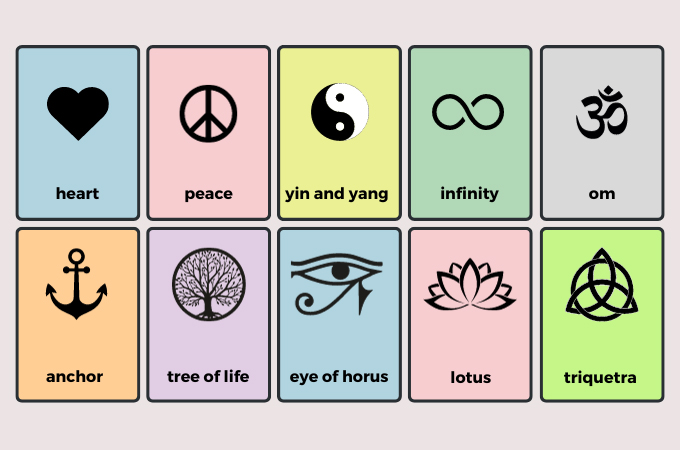
Practical Example
Imagine Sara, a graphic designer who is quiet in groups but fiercely imaginative. She chooses a crescent moon (calm, reflective) with a small spark beside it (creative energy). Together they symbolize her personality better than either symbol would alone. You can build your own combination the same way: one symbol for your core nature, one for your hidden strength.
Cool Symbols to Represent Yourself for Profiles and Digital Spaces
Many people search for cool symbols to represent yourself because they want something stylish for a bio, username, gaming tag, or messaging app. Text and Unicode characters are an easy way to do this.
Examples of Cool Text Symbols
- Stars and sparkles: ✦ ✧ ★ ☆ ✶
- Hearts: ♡ ❤ ❥
- Music and celestial: ♪ ♫ ☾ ☼
- Arrows and lines: ➳ ⟡ ∞
- Crowns and flowers: ♛ ✿ ❀
Tips for Using Digital Symbols Well
- Keep it consistent. Use the same symbol across platforms so people connect it to you.
- Do not overdo it. One to three symbols look intentional, while ten look cluttered.
- Check compatibility. Some characters display as empty boxes on older devices, so test before committing.
- Match your vibe. Soft symbols like ✿ suit a gentle brand, while ✦ or ⚡ suit bold, high-energy personalities.
A symbol that looks cool is a good start, but one with a personal reason behind it will always feel more authentic.
Symbols to Represent Yourself Tattoo Ideas
A tattoo is among the most permanent ways to carry a symbol, so searches for symbols to represent yourself tattoo ideas usually come from people who want something meaningful and lasting.
Popular Tattoo Symbols for Identity
- Minimalist line art: A small mountain, wave, or sun that is easy to age gracefully.
- Semicolon (;): A symbol of continuing your story, widely used in mental health awareness.
- Birth flower or constellation: Tied to your birth month or date.
- Mandala: Balance, wholeness, and spiritual focus.
- Handwritten signature or word: A loved one’s handwriting or a word that defines you.
- Compass or anchor: Direction and stability.
Before You Get Inked
- Research the cultural meaning. Some symbols, such as sacred or tribal designs, belong to specific communities, so learn their significance first.
- Live with the idea first. Draw it, wear it as a temporary tattoo, or use it as a wallpaper for a few months.
- Think about placement. Small, simple symbols work well on wrists or behind the ear, while detailed ones need more space.
- Choose a reputable artist. Clean lines matter most with minimal designs.
A good test is to ask whether the symbol will still be true of you in ten years. If it represents a core value rather than a passing mood, it is a safer choice.
Symbol for Self Love
Self-love is one of the most meaningful things a symbol can represent. If you are looking for a symbol for self love, consider these options:
- Heart with a hand over it: Self-compassion and care.
- Lotus flower: Growing beautifully from difficult circumstances.
- Sunflower: Turning toward the light and your own worth.
- Infinity heart: Unconditional love that begins with you.
- Rose: Beauty and tenderness, thorns included.
- Open arms or a self-hug: Acceptance and comfort.
- Amethyst or rose quartz: Often used in jewelry as reminders of calm and love.
Practical Ways to Use a Self-Love Symbol
- Wear it as a ring or bracelet and touch it when self-criticism shows up.
- Put it on your phone lock screen as a daily reminder.
- Draw it at the top of your journal page before writing.
- Keep a small object, like a smooth stone, in your pocket as a tangible symbol.
The symbol does not create self-love by itself, but it works like a cue that nudges you back toward kindness.
How Can I Symbolize Myself? A Step-by-Step Process
If you are wondering “How can I symbolize myself?”, the process below turns reflection into a finished symbol. It also covers the popular exercises of describing yourself with 5 objects or 10 items, and drawing a symbol with an explanation.
Step 1: List Your Values and Traits
Write down five to ten words that describe you, such as “curious,” “loyal,” “resilient,” or “creative.” Think about what you want people to understand about you first.
Step 2: Choose Objects That Describe You
Try the 5 objects to describe yourself exercise. Pick five things you own or love that reveal who you are, such as a worn notebook, a houseplant, headphones, a travel ticket, or a family recipe card. If you want to go deeper, expand to 10 items that describe yourself. Write one sentence for each item explaining why it fits.
Step 3: Find the Patterns
Look at your objects and words. Do many relate to travel, nature, art, or family? Repeating themes point to your core symbol.
Step 4: Draw Your Symbol With an Explanation
Sketch a simple image that combines your top two or three themes. You do not need artistic skill. A circle with a wave inside it is a perfectly valid symbol. Then write a short explanation, for example: “The circle stands for my need for stability, and the wave shows my love of change.”
Step 5: Test and Refine
Live with the symbol for a week. Does it still feel like you? Simplify it if it is too busy, and adjust the details until it feels right.
Step 6: Put It to Use
Use your symbol in a journal, as a logo for your creative work, in jewelry, or in a profile picture. Using it often gives it weight.
Example in Action
Daniel loves hiking, writing, and coffee. His five objects are a trail map, a fountain pen, a mug, a pair of boots, and a notebook. The pattern is exploration and storytelling, so he draws a winding path ending in a pen nib. His explanation: “I’m always walking toward the next story.” That image becomes his blog logo and a possible future tattoo.
Conclusion
Symbols to represent yourself are more than decoration. They are condensed stories of who you are, what you value, and where you are heading. Whether you choose a universal image like a feather, a flexible character like the tilde, a trendy digital symbol, or a hand-drawn emblem from your own memories, the best choice is the one that feels true to you.
Start small: list your traits, choose a few objects, and sketch a simple design. Let your symbol evolve as you do, because people change and their emblems can too. Most importantly, make sure the meaning is yours, not just borrowed from a trend. When a symbol reflects your real self, it becomes a quiet source of confidence every time you see it.
[…] an attractive card can communicate a message in a personal and meaningful way. With digital design tools becoming increasingly accessible, people no longer need advanced graphic design skills to […]
[…] does one symbol tell the full story. Read the entries for the main objects, the setting, and the people involved. […]