
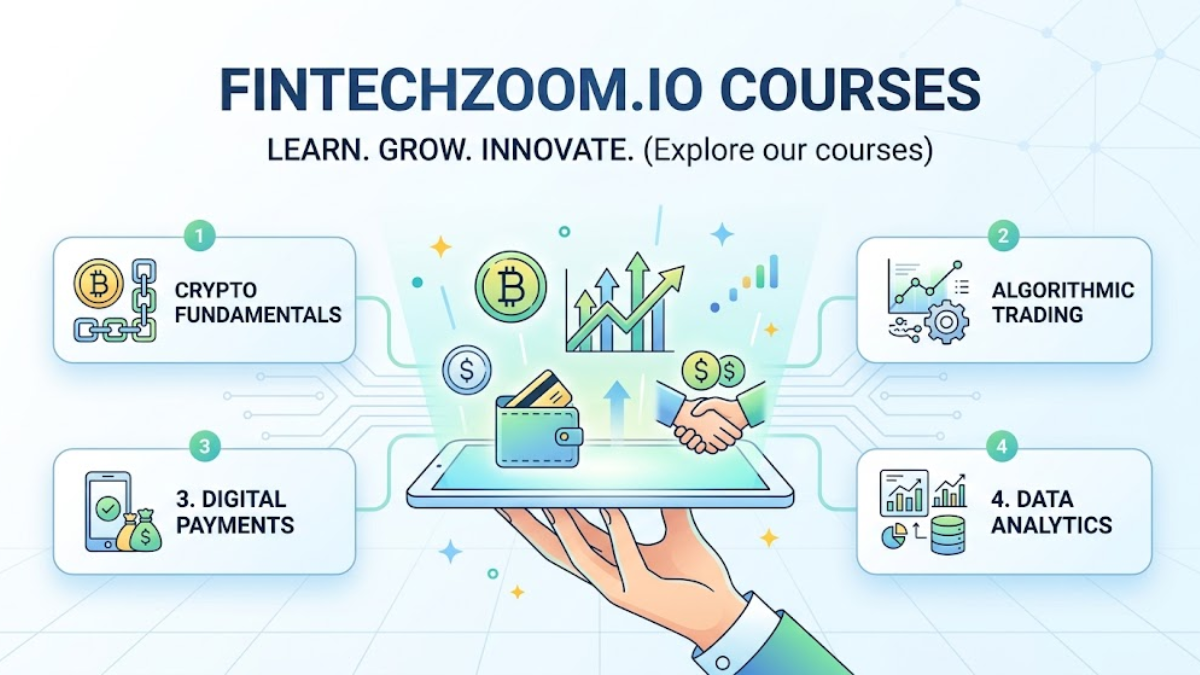
Exploring fintechzoom.io courses? Learn what to expect, who they suit, and whether fintech is in demand, worth it in 2026, different from crypto, or high risk.
Introduction: Why Fintech Education Matters
Financial technology has moved from a niche corner of banking into the core of how money works. Mobile wallets, instant payments, robo-advisors, buy-now-pay-later, digital lending, open banking, and tokenized assets all sit under the fintech umbrella. Every bank, insurer, retailer, and startup now needs people who understand both finance and technology.
That is why searches for fintechzoom.io courses keep growing. People want a structured way to understand markets, payments, digital assets, and financial innovation without piecing together scattered blog posts and videos. A good course turns a confusing industry into a clear learning path.
This guide explains what fintechzoom.io courses are meant to offer, who benefits from them, and how to judge any fintech course before spending money. Along the way, it answers four questions beginners ask constantly: Is fintech in high demand? Is fintech worth it in 2026? Is fintech the same as crypto? Is fintech a high-risk industry?
A quick note on accuracy: course catalogs, prices, and formats change often. Always confirm current details on the official FinTechZoom.io website before enrolling.
What Are FinTechZoom.io Courses?
FinTechZoom is best known as a financial news and market information brand covering stocks, crypto, forex, and fintech trends. Courses connected to a brand like this typically aim to turn that market-awareness content into structured learning: lessons, explainers, and practical frameworks for understanding financial technology and digital markets.
What this type of course usually covers
Courses in this category generally focus on practical literacy rather than academic theory. Expect topics such as how digital payments work, how markets and trading platforms operate, how to read financial news, and how emerging technologies like blockchain and AI are changing finance.
What to verify before enrolling
Because offerings change, check the following on the official site: the current course list, whether content is self-paced or live, who the instructors are, whether a certificate is provided, and what the refund policy says. Treat any course page that skips these basics with caution.
Why Fintech Skills Are Becoming Essential
Finance used to be a closed profession. Today, a product manager at a payments startup, a marketer at a neobank, and a compliance analyst at a traditional bank all need working knowledge of financial technology.
Three forces driving the shift
- Digital-first banking: Customers expect to open accounts, send money, and borrow from a phone in minutes.
- Regulation catching up: Rules around data, payments, and digital assets create demand for people who understand compliance and technology together.
- Embedded finance: Non-financial brands now offer payments, lending, and insurance inside their own apps, widening the job market beyond banks.
Practical example
A ride-hailing app adding a wallet and driver cash-out feature needs product managers who understand payment rails, fraud risk, and licensing. None of those people necessarily started their careers in banking. Many learned through short, focused courses.
Is Fintech in High Demand?
Yes, in most regions fintech skills are in strong demand, though demand is uneven across roles and markets. Hiring tends to be strongest in software engineering, data analysis, product management, risk and compliance, cybersecurity, and customer-facing roles tied to digital finance.
Where demand is strongest
Payments, digital lending, wealthtech, insurtech, and regtech continue to hire. Emerging markets with large unbanked populations and rapid mobile adoption, including much of South Asia, Africa, and Southeast Asia, have seen especially fast growth in mobile money and digital wallets.
Where demand is softer
Funding cycles affect fintech hiring. After heavy investment years, many companies tightened budgets, cut roles, and focused on profitability. Entry-level roles can be competitive, and generalist positions are harder to land than specialized ones.
What this means for learners
Demand is real, but it rewards specific skills. Someone who can analyze transaction data, understand fraud patterns, or explain regulatory requirements is far more employable than someone with only general fintech awareness. Pair any course with a portfolio project that proves you can apply what you learned.
Is Fintech Worth It in 2026?
For many people, yes, but the answer depends on your goal, your background, and how you use the learning.

When fintech is worth it
It makes sense if you already work in finance, technology, or business and want to move toward digital finance. It also fits founders, analysts, and professionals who need to understand how financial products are built and regulated. The skill overlap between finance and tech is where salaries and opportunities tend to be strongest.
When to be cautious
If you are expecting a quick career switch from a single beginner course, you may be disappointed. Employers usually want evidence of skill: projects, certifications, internships, or relevant experience. A course is a starting point, not a guarantee.
A simple worth-it test
Before paying for any course, write down the outcome you want, such as a job change, a promotion, a freelance service, or personal financial knowledge. Then check whether the course syllabus directly supports it. If you cannot connect the lessons to the outcome, the course is probably not worth it for you.
Practical example
A bank operations officer who completes a course on digital payments and fraud basics, then volunteers to help the bank’s mobile app team, is positioning for an internal move. The course matters because it is paired with action.
Is Fintech the Same as Crypto?
No. This is one of the most common misunderstandings. Fintech is the broad category of technology used to deliver or improve financial services. Cryptocurrency is one specific area that sometimes falls under that umbrella.
What fintech includes
Mobile banking apps, peer-to-peer payments, online lending platforms, robo-advisors, insurance technology, accounting software, credit scoring tools, and payment processors are all fintech. Most of them have nothing to do with crypto.
Where crypto fits in
Crypto and blockchain technology are part of fintech when used for payments, tokenized assets, or decentralized finance. But crypto trading, token speculation, and blockchain development are only one slice of a much larger field.
Why the distinction matters for course choice
If you take a course expecting a general fintech education and find it is mostly about crypto trading, you may miss core topics like payments infrastructure, lending, and compliance. Read the syllabus carefully and look for balanced coverage.
Is Fintech a High-Risk Industry?
Fintech carries real risks, but “high risk” depends on which part of the industry you mean and from whose perspective: employee, investor, founder, or customer.
Risks for companies and investors
Fintech firms face regulatory scrutiny, cybersecurity threats, fraud, funding volatility, and competition from both banks and other startups. Many startups fail, and valuations can swing sharply. Investors should treat early-stage fintech as high risk.
Risks for employees
Job security varies. Startups can lay off staff quickly, while established fintech and banks offer more stability. Working in regulated areas such as compliance and risk can be more resilient than roles tied to a single product.
Risks for customers
Users face data privacy concerns, scams, and platform failures. Speculative products, especially certain crypto and leveraged trading offerings, can lead to significant losses.
Managing the risk
Diversify your skills, prefer employers with clear business models, and learn the regulatory and security side of the industry. Risk literacy is itself a valuable fintech skill, and a good course should teach it.
Core Topics a Strong Fintech Course Should Cover
Whether you choose fintechzoom.io courses or another provider, use this checklist to judge the curriculum.
Foundations
- How the financial system works: banks, payment networks, central banks, and markets
- Core products: accounts, cards, loans, insurance, and investments
- Key terms such as KYC, AML, API, open banking, and interoperability
Technology
- Payments infrastructure and digital wallets
- Blockchain and digital assets, explained neutrally with risks included
- Artificial intelligence in credit scoring, fraud detection, and customer service
- Cybersecurity and data protection basics
Markets and analysis
- Reading financial news and market data
- Understanding volatility, liquidity, and risk management
- Basic technical and fundamental analysis concepts
Regulation and ethics
- Licensing, consumer protection, and data privacy rules
- Responsible innovation and avoiding misleading financial claims
A course that covers only trading signals or hype and skips regulation and risk is not a complete fintech education.
Who Should Take Fintech Courses
Different learners need different things, so match the course to your profile.
Beginners and career changers
Start with fundamentals: how money moves, what fintech products exist, and what jobs the industry offers. Look for short, structured lessons with quizzes or small projects.
Finance professionals
Bankers, accountants, and analysts benefit from modules on digital payments, APIs, blockchain, and data analytics. These help bridge the gap between traditional finance and technology teams.
Tech professionals
Developers and data specialists should focus on financial concepts: how payments settle, how lending decisions are made, and which regulations apply. Understanding the domain makes your technical work far more valuable.
Entrepreneurs and freelancers
If you are building a fintech product or offering services such as bookkeeping automation or payment integration, prioritize compliance, unit economics, and user trust.
Investors and curious readers
If your goal is understanding markets rather than changing careers, choose lighter, news-oriented courses and be skeptical of anything promising guaranteed returns.
How to Evaluate a Course Before You Enroll
The internet is full of finance courses, and quality varies widely. Use these checks before paying.
Look for transparency
A trustworthy provider clearly lists the syllabus, instructor background, duration, price, and refund terms. Vague promises such as “become a fintech expert in days” are a red flag.
Check for realistic claims
Avoid courses that guarantee profits, job placement, or income. Financial markets involve risk, and credible educators say so openly.
Look for practice, not just theory
The best courses include case studies, exercises, simulations, or capstone projects. Applying concepts is what makes them stick and gives you something to show employers.
Read independent reviews
Search for reviews on third-party sites and forums, not only testimonials on the provider’s own page. Look for comments about depth, support, and whether the content stays updated.
Start small
If possible, try a free lesson, trial, or lower-priced introductory module before committing to a larger program.
A Practical 90-Day Fintech Learning Plan
A course works best inside a plan. Here is a simple structure you can adapt.
Days 1 to 30: Build the foundation
Learn the basics of banking, payments, and financial products. Follow fintech news daily and keep a notebook of new terms. Pick one sector, such as payments, lending, or wealthtech, to focus on.
Days 31 to 60: Go deeper and apply
Take a focused course module on your chosen sector. Create a small project, for example comparing how three mobile wallets handle fees, security, and onboarding, and write up your findings.
Days 61 to 90: Show your work
Publish your project on LinkedIn or a personal blog, update your resume with relevant skills, and reach out to professionals in your target area. Apply for roles, internships, or freelance work that match your new knowledge.
Practical example
Someone targeting a fintech product role might analyze a digital lending app’s user journey, identify friction points in onboarding, and propose improvements. That single case study demonstrates more than a certificate alone.
Common Mistakes to Avoid
- Chasing hype: Choosing courses based on trending topics rather than your goals.
- Ignoring regulation: Skipping compliance and risk topics, which are central to the industry.
- Treating a course as a shortcut: Skills and experience still matter to employers.
- Confusing education with advice: Course content about markets is not personalized financial advice. Make investment decisions based on your own research and, where appropriate, a licensed professional.
- Learning without applying: Passive watching rarely builds real skill.
Conclusion
Fintech is one of the most influential areas of modern business, and learning it can open doors in finance, technology, entrepreneurship, and investing. Fintechzoom.io courses can be a useful way to build structured knowledge, provided you confirm the current curriculum, check that claims are realistic, and match the content to your own goals.
To recap the key questions: fintech is in demand, especially for specialized skills; it is worth it in 2026 for people who pair learning with practical experience; it is not the same as crypto, which is only one part of a much broader field; and it carries real risks that vary by role and sector, which is why risk and regulation knowledge matters.
Your next step is simple. Define your goal, review the official course details, choose a focused path, and build a small project as you learn. Skills you can demonstrate will always outweigh certificates you can only list.
[…] you encountered this name while reading financial literacy blogs, analyzing digital marketing trends, or researching investment entity histories, understanding what […]