
Which fintech companies are listed on the Nasdaq? Explore top fintechzoom.io nasdaq stocks, how they compare with NYSE, how to read fintechzoom.io nasdaq price pages, and what drives tech sell-offs.
Introduction: Why Nasdaq Fintech Stocks Matter
Financial technology has moved from the edge of the market to its center. Payments, digital banking, online brokerage, lending, crypto trading and embedded finance now touch billions of daily transactions, and many of the businesses behind them trade on one exchange: the Nasdaq. Investors who search for terms like “fintechzoom.io nasdaq” are usually trying to answer practical questions. Which fintech companies are actually listed there? How are they performing? Where can I find a price, a chart or a forecast?
This guide answers those questions in one place. It explains what the Nasdaq fintech universe looks like, profiles well-known listed companies, compares the Nasdaq with the NYSE, and shows how to use financial news and data sites such as FinTechZoom to research stocks responsibly. It also addresses common related questions, including why tech stocks fall on certain days and how to think about price predictions.
Important note: this article is educational, not investment advice. Listings change through IPOs, mergers, delistings and exchange transfers, so always confirm a company’s current ticker and exchange on Nasdaq.com or the company’s investor relations page before acting.
What Is Nasdaq Fintech?
“Nasdaq fintech” is not an official index category. It is a shorthand people use for financial technology companies whose shares trade on the Nasdaq Stock Market. It can also refer to the Nasdaq exchange’s own technology business, which sells trading, clearing, surveillance and market-infrastructure software to exchanges and banks worldwide.
The two meanings of the phrase
- Fintech companies listed on the Nasdaq: firms such as PayPal, Affirm, SoFi, Coinbase and Robinhood.
- Nasdaq as a fintech provider: Nasdaq, Inc. (ticker NDAQ) itself earns revenue from software, data and anti-financial-crime tools, which is why it is often grouped with fintech.
For most readers, the first meaning is what matters, and it is the focus of this guide.
Why the Nasdaq Attracts Fintech Companies
The Nasdaq has long been associated with growth and technology. It began in 1971 as the world’s first electronic stock market, so a fintech listing fits its identity. Several factors draw young financial technology firms:
Brand alignment with technology
Listing alongside Apple, Microsoft and Nvidia signals that a company sees itself as a technology business rather than a traditional financial institution. That can influence how analysts value it.
Index and fund inclusion
Large Nasdaq-listed companies can qualify for the Nasdaq-100, which is tracked by popular exchange-traded funds. Inclusion can bring steady passive buying.
Cost and market-data services
The exchange offers listing packages, investor-relations tools and analytics that appeal to growth companies, many of which are still working toward profitability.
Retail investor visibility
Nasdaq-listed names are heavily traded by retail investors, which matters for consumer-facing brands such as brokerage apps and buy-now-pay-later platforms.
Major Fintech Companies Listed on the Nasdaq
Below is a representative list based on listings known at the time of writing. It is not exhaustive, and you should verify each ticker before relying on it.
Payments and money transfer
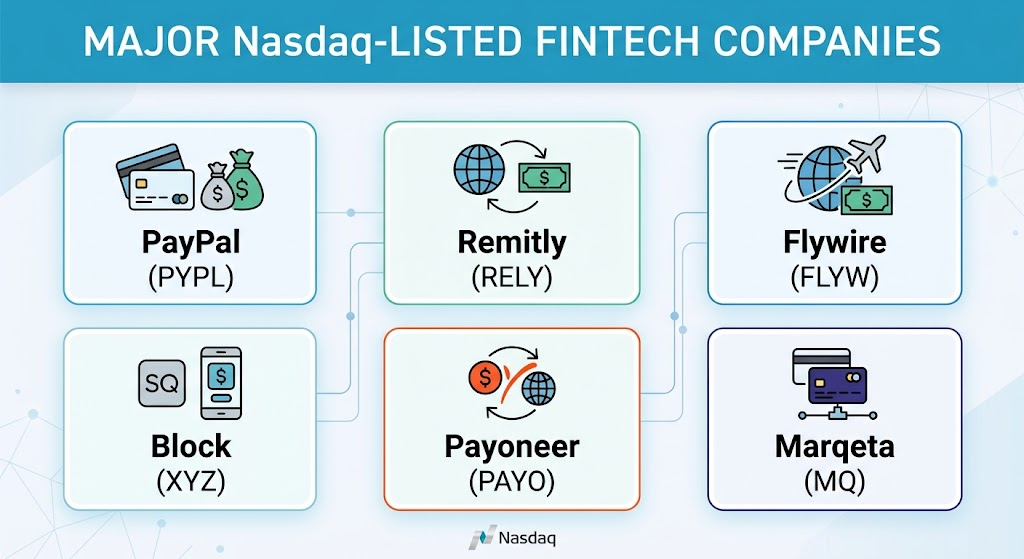
- PayPal (PYPL): One of the largest digital payment platforms, covering PayPal, Venmo and Braintree.
- Block (XYZ): Parent of Square, Cash App and Afterpay. The company moved its listing to the Nasdaq in early 2025 and changed its ticker.
- Remitly (RELY): Focused on cross-border remittances to families abroad.
- Payoneer (PAYO): Cross-border payments for freelancers and small businesses.
- Flywire (FLYW): Payment software for education, healthcare and travel.
- Marqeta (MQ): Card-issuing infrastructure used by many fintech apps.
Lending and buy-now-pay-later
- Affirm (AFRM): Pay-over-time financing at checkout.
- Upstart (UPST): AI-driven lending marketplace working with banks and credit unions.
- SoFi Technologies (SOFI): A digital bank offering loans, investing, credit cards and banking.
Brokerage, trading and crypto
- Robinhood Markets (HOOD): Commission-free trading, crypto and retirement accounts.
- Coinbase Global (COIN): One of the largest US crypto exchanges.
- Interactive Brokers (IBKR): A global electronic broker.
- eToro (ETOR): Social trading platform that listed in the US in 2025.
Digital banking and software
- Chime Financial (CHYM): Consumer neobank that went public in 2025.
- Dave (DAVE): Low-cost banking and small advances.
- Intuit (INTU): QuickBooks, TurboTax and Credit Karma, a major financial software company.
- MercadoLibre (MELI): Latin American e-commerce giant whose Mercado Pago unit is a large fintech business.
Practical example: the same sector, different businesses
Notice how different these companies are. Affirm earns revenue from merchant fees and interest, Coinbase depends on trading volumes, and Intuit sells subscriptions. When crypto prices fall, Coinbase may feel it quickly while Intuit barely notices. Lumping them together as “fintech” hides important differences.
How to Use fintechzoom.io Nasdaq Pages for Research
FinTechZoom is a financial news and market-information site, and people often search for “fintechzoom.io nasdaq” to find articles about Nasdaq indices, tech stocks and fintech movers. Used well, a news aggregator is a good starting point, not an ending point.
What these pages are good for
- Quick market summaries and headline context.
- Discovering which sectors or tickers are in the news.
- Finding links to earnings releases and company announcements.
What to verify elsewhere
- Prices: Real-time quotes come from your broker, Nasdaq.com or a licensed data provider. News sites may show delayed data.
- Financials: Use SEC filings (10-K and 10-Q) on EDGAR for audited figures.
- Claims: Cross-check any dramatic statement with a second source.
A simple research workflow
- Read a news summary to learn what moved.
- Open the company’s latest earnings release.
- Check revenue growth, profit margins and cash flow.
- Compare the stock’s valuation with direct competitors.
- Decide whether it fits your goals and risk tolerance.
Understanding Fintechzoom.io Nasdaq Stock Price and Price Searches
Searches such as “fintechzoom io nasdaq stock price” and “fintechzoom io nasdaq price” usually mean one of two things: the level of the Nasdaq Composite or Nasdaq-100 index, or the price of a specific Nasdaq-listed stock.
Index price versus stock price
An index level, such as the Nasdaq Composite, is a weighted measure of thousands of companies and is not something you can buy directly. To invest, you would buy an exchange-traded fund or a futures product that tracks it. A stock price is the cost of one share of one company.
Reading a quote correctly
- Last price and change: The most recent trade and the move since the prior close.
- Volume: How many shares traded. Unusually high volume often signals news.
- Market capitalization: Share price multiplied by shares outstanding, a better size measure than price alone.
- 52-week range: Shows where the stock sits between its yearly low and high.
Practical example
Suppose one fintech stock trades at $20 and another at $200. The cheaper stock is not necessarily a bargain. If the first company has ten times as many shares, both could have the same market capitalization. Always compare valuation ratios and company size, not the headline price.
Fintechzoom.io Nasdaq Prediction: How to Treat Forecasts
Searches for “fintechzoom io nasdaq prediction” reflect a natural desire to know where prices are heading. The honest answer is that nobody can predict short-term market moves reliably, including analysts, algorithms and websites.
Where predictions come from
- Analyst price targets: Estimates from brokerage research teams, usually for 12 months ahead.
- Technical analysis: Chart-based projections using trends and support or resistance levels.
- Algorithmic or AI forecasts: Models that extrapolate from historical data and often fail when conditions change.
Healthy ways to use forecasts
- Treat them as scenarios, not promises.
- Compare several forecasts and note the range of opinions.
- Look at the assumptions behind each: growth rates, interest rates, regulation.
- Never invest money you cannot afford to lose based on a single prediction.
Why Are Tech Stocks Down Today?
Anyone who follows Nasdaq fintech stocks will eventually ask this question, because the index is heavily weighted toward technology and growth companies. While the cause of any single day’s drop requires checking the day’s news, several recurring drivers explain most declines.
Interest rate expectations
Growth companies are valued on profits expected far in the future. When investors expect higher rates, those future profits are discounted more heavily, so prices often fall. Hawkish comments from central bankers or strong inflation data can trigger sell-offs.
Disappointing earnings or guidance
A large technology company missing expectations can drag the whole sector, and fintechs often move in sympathy.
Valuation concerns and profit-taking
After a strong rally, investors may sell to lock in gains, causing sharp but sometimes short-lived pullbacks.
Regulation and geopolitics
New rules on crypto, lending or data, along with trade tensions, can hit specific fintech subsectors.
How to find today’s reason
Check a reputable financial news source, the day’s economic calendar, and the company’s own press releases. For fintech names, also look at crypto prices, consumer-credit data and payment-volume commentary.
Is It Better to Be on NYSE or Nasdaq?
There is no universal answer. Both are major, well-regulated US exchanges, and many excellent companies trade on each. The better choice depends on the company’s priorities and, for investors, matters far less than the quality of the business.
How they differ
- Trading model: The NYSE blends floor-based auctions with electronic trading and uses designated market makers. The Nasdaq is fully electronic, with competing market makers.
- Reputation: The NYSE is associated with established blue-chip firms, while the Nasdaq is known for technology and growth.
- Fees and services: Listing costs and bundled services differ and are a factor in company decisions.
- Indexes: NYSE and Nasdaq stocks can both belong to the S&P 500, but the Nasdaq-100 includes only Nasdaq-listed non-financial companies.
What it means for investors
For most investors, the exchange has little effect on returns. Liquidity, fundamentals and valuation matter much more. The exchange can matter indirectly through index inclusion and branding.
Practical example
Some fintechs have chosen the NYSE, including Toast, Nu Holdings and Circle, while others chose the Nasdaq. Companies have also switched: Block moved from the NYSE to the Nasdaq. These moves illustrate that both venues are viable.
Risks of Investing in Nasdaq Fintech Stocks
Fintech stocks can deliver fast growth, but they come with distinct risks.
Volatility
Many fintech shares swing widely on earnings, rate changes or sentiment. Double-digit moves in a day are not unusual.
Credit and economic sensitivity
Lenders such as Upstart and Affirm depend on borrowers repaying. A weakening economy can raise defaults and funding costs.
Regulatory exposure
Banking partnerships, consumer-protection rules and crypto regulation can change business models quickly.
Competition
Big banks, large technology firms and well-funded startups all compete for the same customers, pressuring fees and margins.
Profitability questions
Several fintechs only recently became profitable. Check whether growth is being bought through heavy marketing or credit losses.
How to Evaluate and Invest in Nasdaq Fintech Stocks
A disciplined approach helps reduce emotional decisions.
Metrics worth tracking
- Revenue growth and take rate: How fast the business grows and how much it earns per dollar processed.
- Total payment volume or assets under custody: Depending on the model, the key activity measure.
- Net income and free cash flow: Evidence of real profitability.
- Credit performance: Delinquency and loss rates for lenders.
- Active users and retention: Signs of customer loyalty.
Ways to gain exposure
- Individual stocks: Highest potential reward and highest risk.
- Fintech ETFs: Diversify across many companies in one trade.
- Nasdaq-100 funds: Broad technology exposure that includes a few fintech leaders.
Practical example: building a diversified basket
An investor interested in the sector might spread exposure across payments, lending and brokerage rather than owning only crypto-linked names. That way, a downturn in one area does not dominate the portfolio. This is an illustration of diversification, not a recommendation.
The Future of Fintech on the Nasdaq
Several trends are likely to shape which companies list and how they perform.
The IPO window
After a quiet stretch, several fintechs listed in 2025, showing renewed appetite. Future listings depend on market conditions and interest rates.
Stablecoins and digital assets
Clearer regulation could expand the opportunity for payments and crypto-related companies.
Artificial intelligence
AI is being used in underwriting, fraud detection and customer service, which could improve margins for well-run firms.
Embedded finance
Software and e-commerce companies increasingly offer payments and lending inside their own apps, blurring the line between fintech and other sectors.
Consolidation
Expect continued mergers and acquisitions as larger players buy specialized startups, which can change the list of listed companies.
Conclusion
So, which fintech companies are listed on the Nasdaq? A broad group, including PayPal, Block, Affirm, SoFi, Coinbase, Robinhood, Upstart, Marqeta, Remitly, Payoneer, Intuit, Interactive Brokers and newer public names such as Chime and eToro. The category spans payments, lending, brokerage, crypto and software, and each segment responds differently to interest rates, regulation and consumer behavior.
If you use “fintechzoom.io nasdaq” searches to monitor the market, treat news pages as a launchpad. Confirm prices with a live data source, read the filings, treat predictions as scenarios, and remember that the choice between NYSE and Nasdaq matters far less than the strength of the underlying business. When tech stocks are down, look at rates, earnings and sentiment before reacting.
Finally, listings and valuations change constantly. Verify every ticker and figure at the time you read this, and consider speaking with a licensed financial adviser before making investment decisions.
Frequently Asked Questions
Is fintechzoom.io nasdaq an official Nasdaq product?
No. It is a search phrase people use to find Nasdaq-related content on the FinTechZoom website. Official data comes from Nasdaq.com and company filings.
Are all fintech stocks on the Nasdaq?
No. Some trade on the NYSE and others on foreign exchanges.
Can I buy the Nasdaq itself?
You cannot buy an index directly, but you can buy ETFs or funds that track it.
[…] guide explains what fintechzoom.io courses are meant to offer, who benefits from them, and how to judge any fintech course before […]