
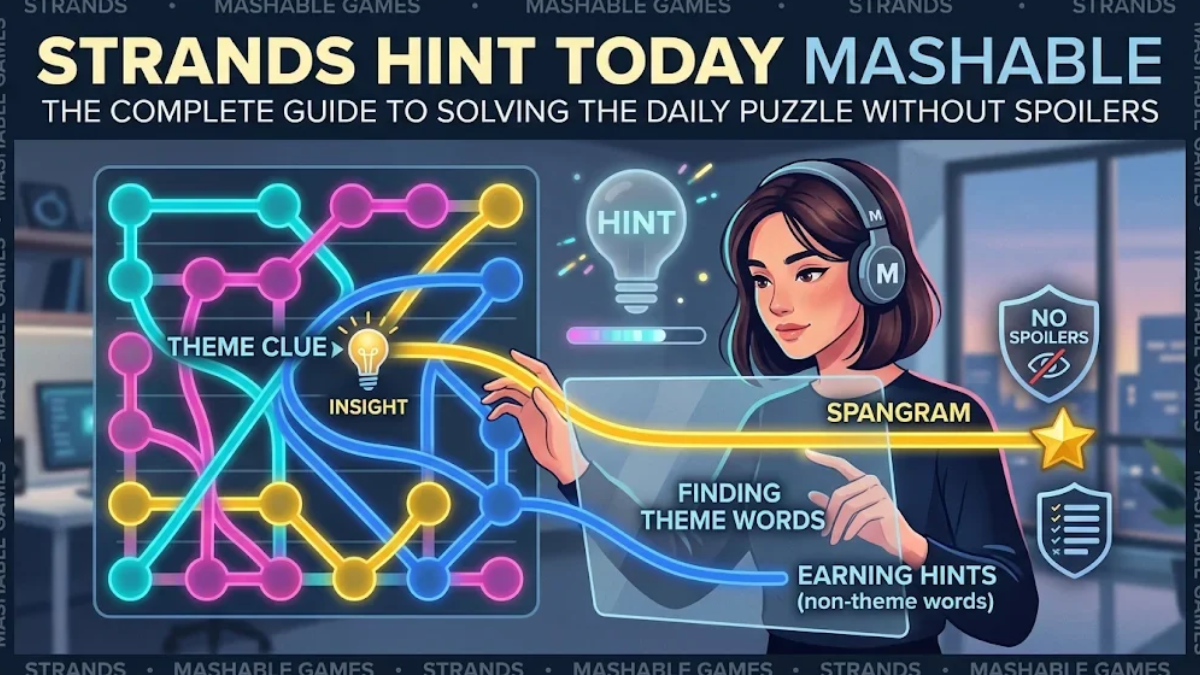
Stuck on today’s puzzle? Our complete guide to the Strands hint today Mashable style shows you how to use hints, find the spangram, and solve faster without spoilers.
Every morning, millions of word-game fans open the New York Times Strands puzzle, stare at a grid of 48 letters, and wonder where to begin. Some solve it in minutes. Others get stuck on a single stubborn word and end up searching for the Strands hint today Mashable publishes alongside its daily puzzle coverage.
That search habit is worth taking seriously. Strands are unlike Wordle or Connections. You aren’t guessing a single word or sorting 16 tiles into categories. You are hunting for themed words hidden in a tangled letter grid, and one wrong assumption can send you in circles for twenty minutes.
This guide explains how Strands works, why hint articles like Mashable’s have become part of many players’ routines, and how to use them wisely. Whether you want a nudge or just want to get better at the game, you’ll find practical strategies, worked examples, and habits that will make you faster.
What Are Strands and Why Do Players Search for Hints?
Strands is a daily word-search-style puzzle from The New York Times Games. Each puzzle has a theme, shown as a short clue at the top of the screen. Your job is to find every word related to that theme, and one special word, called the spangram, describes the theme itself and stretches from one side of the grid to the other.
Why the game creates so many hint searches
Strands have a particular difficulty profile. The theme clues are often playful or vague, so the connection between the clue and the answers isn’t always obvious. The grid also doesn’t give you a word list, so you have to discover the vocabulary yourself. When the theme is abstract or built on wordplay, even strong solvers hit a wall.
That’s why queries like “Strands hints for today” and “Strands hint today Mashable” are so common. People don’t necessarily want the full answer. They want enough direction to get unstuck, which is where a well-built hint article earns its place.
How Mashable Covers the Strands Puzzle Each Day
Mashable is one of several outlets that publish a daily walkthrough for popular puzzle games, and its Strands coverage follows a recognizable format. Rather than opening with the answers, these articles typically start with a short explanation of the game, then offer a graduated set of clues.
The typical structure of a daily hint article
A standard daily post usually moves through the following stages:
- A brief reminder of the game’s rules for newcomers
- A light, spoiler-free hint about the theme
- A more specific nudge, often the starting letter or letter count of the spangram
- A list of the theme words, placed lower down the page
- The full solution, including the spangram
This layered approach is what makes the Strands hint today Mashable search so useful. You decide how much help you want, and you can stop reading the moment you have what you need.
Why the date matters
Strands resets every day, and each puzzle is tied to a specific date. That’s why you see searches that include a date, such as “Strands hint today Mashable Oct 27” or “July 28.” Players looking for a past puzzle, perhaps to catch up on a missed streak or settle a debate with a friend, add the date to find that specific day’s article. If you want today’s hints, search without a date or add the current one.
Understanding the Strands Grid and Core Rules
Before you can use hints effectively, you need a solid grasp of the mechanics. The grid is six columns wide and eight rows tall, and every letter belongs to exactly one answer.
The rules in plain language
- Words are built by connecting adjacent letters, including diagonals.
- A path can bend and turn, but it cannot reuse a letter.
- Every letter in the grid is part of some answer, so nothing is wasted.
- The spangram touches two opposite edges of the grid.
- Words must be at least four letters long to count.
That fourth rule matters more than it seems. If you find a valid word that isn’t part of the theme, it doesn’t count as a theme word, but it does count toward the in-game hint meter. Find enough of those non-theme words and the game gives you a free hint.
Why the “every letter is used” rule is your best friend
Because the entire grid is filled, the puzzle is partly a jigsaw. When you find two or three theme words, the leftover letters become far more constrained. Those isolated clusters of letters in a corner often point straight at the missing answers.
How to Read the Theme Clue Like a Puzzle Editor
The theme clue is the most important sentence on the screen, and most people read it too literally. Strands clues are written by editors who enjoy misdirection, so the surface meaning is often just the first layer.
Common clue styles
Strands themes tend to fall into a few patterns:
- Straight categories, such as types of trees or kitchen tools
- Wordplay themes, where the answers share a hidden trait like containing a smaller word
- Phrase completion themes, where each answer follows or precedes a common word
- Pop culture themes, tied to movies, music, or famous people
A practical example
Imagine a hypothetical clue that reads “Weekend plans.” You might think of activities like hiking or shopping. But the actual answers could be words like BRUNCH, NAPPING, and MARKET, all things people do on a Saturday. The category is loose, so you have to think about what the editor would reasonably include rather than what’s technically correct.
When the clue feels broad, treat it as an invitation to brainstorm, not as a definition. Write down five or six words that fit and scan the grid for them.
Finding the Spangram: The Fastest Route to Momentum
The spangram is the keystone of every puzzle. It describes the theme, it spans the grid, and once you find it, the rest of the puzzle usually opens up.
Why start with the spangram
The spangram is often the longest answer, and it always links opposite sides of the grid. That gives you a built-in constraint. You know its path starts on one edge and ends on the opposite one, which narrows the search considerably.
Techniques for hunting it down
- Look at the leftmost and rightmost columns, or the top and bottom rows, for letters that could start or end a long word.
- Check for common word endings near the edges, such as -ING, -TION, or -ERS.
- Use the theme clue to guess the vocabulary. A spangram usually names the category itself, like “SEASONINGS” for a spice theme.
- Try compound words, since many spangrams are two words joined together.
Hint articles frequently give the spangram’s starting letter or its length. Even that small piece of information can turn a twenty-minute struggle into a thirty-second find.
Using Hints Wisely: Spoiler-Free and Full-Answer Approaches
There is no single correct way to use a hint. The right approach depends on what you want from the game that day.
The spoiler-free ladder
If you prefer to preserve the satisfaction of solving, climb the ladder slowly:
- Read only the theme hint and then close the article.
- Return to the puzzle and try for five minutes.
- If you’re still stuck, reread the article and look at the spangram clue.
- Only scroll to the word list as a last resort.
The speed-solver approach
If you play mainly to protect a streak or you’re short on time, going straight to the answer list is perfectly fine. Games should fit your life, not the other way around.
Combining outside hints with the in-game hint system
The game’s own hint button is a useful middle ground. Each hint reveals the letters of one theme word, and you earn them by finding extra non-theme words. Many players use the in-game system first and consult an outside article such as the Strands hint today Mashable page only when they still can’t crack the spangram.
A Step-by-Step Walkthrough of a Typical Solve
Let’s walk through a hypothetical puzzle to show how these pieces fit together. Suppose the theme clue reads “Sweet endings.”
Step one: brainstorm the category
You think of desserts: CAKE, PIE, TART, FUDGE, and similar words. You scan the grid and spot a cluster of letters near the middle that spells BROWNIE. That’s a promising theme word.
Step two: confirm with the leftover letters
Once BROWNIE is locked in, you notice that the letters around it are now isolated. A group in the upper-left corner looks like it could spell CUPCAKE, which fits. Two words down, with a clear pattern emerging.
Step three: use the spangram clue
Still missing the spangram, you check a hint article, which says it starts with the letter D and is a single word describing the whole theme. You search the edges for a D and find one on the left side. Tracing a path across the grid, you uncover DESSERTS, connecting left to right.
Step four: finish with the remaining letters
With the spangram placed, only a few letters remain. They form the final words almost automatically. This is the pattern in most puzzles: the hardest part is the first breakthrough, and everything after that falls quickly.
Common Mistakes That Slow Solvers Down
Even experienced players fall into predictable traps. Knowing them in advance can save you real time.
Fixating on the wrong theme interpretation
If you’ve been staring at the grid for ten minutes, your reading of the clue may be wrong. Step away, reread the clue as if you’d never seen it, and brainstorm a completely different category.
Ignoring short words
Four- and five-letter words are easy to overlook because they feel too small to matter. But they are often theme answers, and finding them first reduces the number of loose letters.
Forgetting about diagonals
Many players trace words only horizontally and vertically. Diagonal connections are legal and frequently necessary, so train your eye to scan all eight directions from any letter.
Using hints too early
Reaching for a hint after thirty seconds robs you of the moment where your brain makes a connection by itself. A short struggle is part of the fun, and it builds the pattern recognition that makes you faster over time.
Building Daily Habits That Improve Your Strands Skills
Hint articles are a safety net, but the long-term goal for most players is to need them less. A few small habits can speed up that progress.
Play at the same time each day
A consistent routine, such as playing with morning coffee, helps your brain settle into puzzle mode. Many solvers report that they perform better when they treat the game as a daily ritual.
Review the answers after you finish
After each puzzle, spend thirty seconds looking at the full solution, especially for the words you missed. You’ll start to notice how the editors think, including their favorite word types, their love of compound spangrams, and their sense of humor.
Keep a mental library of theme types
Over weeks of play, you’ll build an internal catalog: food themes, wordplay themes, geography themes, and so on. The next time a similar clue appears, you’ll recognize the pattern immediately.
Play alongside other puzzles
Wordle, Connections, and the Mini crossword all train related skills. Connections sharpen your category thinking, while Wordle builds letter-pattern awareness. Together they make Strands feel more intuitive.
Where to Find Reliable Strands Hints Online
Because the puzzle is so popular, plenty of sites publish hints, but quality varies. Here is how to choose well.
What to look for in a good hint source
- Spoiler discipline, with hints separated from answers by clear breaks
- Daily updates that match the current puzzle date
- Accuracy, since a wrong answer list wastes your time
- Readable layout, with no endless scrolling or intrusive pop-ups
Why established outlets are a safe choice
Large publications such as Mashable have editorial teams who verify the puzzle each day, and their pages tend to be organized and easy to navigate. That reliability is a big reason the Strands hint today Mashable search remains so common. If you’re looking at a past puzzle, remember to include the date in your search so you land on the correct archive page rather than today’s.
A note on timing
New puzzles generally go live at midnight local time, and hint articles usually appear shortly after. If you search very early and nothing comes up, check back a little later in the morning.
Frequently Asked Questions About Daily Strands Hints
Players often have the same handful of questions, so here are quick answers.
Do hints affect my streak?
Using an outside article doesn’t change anything in the game itself. Your streak depends only on whether you complete the puzzle. The in-game hint button likewise doesn’t penalize you.
Is it cheating to read a hint?
Not at all. Strands is a casual daily puzzle, and there’s no competition forcing you to play a certain way. Use help in whatever way makes the game enjoyable.
Can I find hints for older puzzles?
Yes. Search for the Strands hint with the specific date, for example “Strands hint today Mashable October 26,” and you’ll usually find the matching archive entry.
What if the hint doesn’t make sense?
Occasionally a theme depends on wordplay that isn’t obvious until you see an answer. In that case, check the full word list, then work backward to understand the logic. That understanding will help you spot similar themes later.
Conclusion: Turn Daily Hints Into Lasting Skill
Strands rewards curiosity, patience, and a willingness to look at a problem from a new angle. Hint articles, including the daily Strands hint today Mashable coverage, make the game more accessible by giving you just enough direction to keep going. They let you decide how much help you want, from a gentle nudge about the theme to a complete answer list.
The best approach is to use hints as a learning tool, not a crutch. Read the theme clue carefully, hunt for the spangram first, scan every direction including diagonals, and review the solutions after you finish. Over time, you’ll notice that you reach for outside help less often and enjoy the puzzle more.
Whether you’re protecting a long streak or just playing for fun, the combination of smart strategy and a trustworthy daily hint source will keep your mornings both challenging and satisfying. Bookmark a reliable page, build your routine, and come back tomorrow for the next grid.